
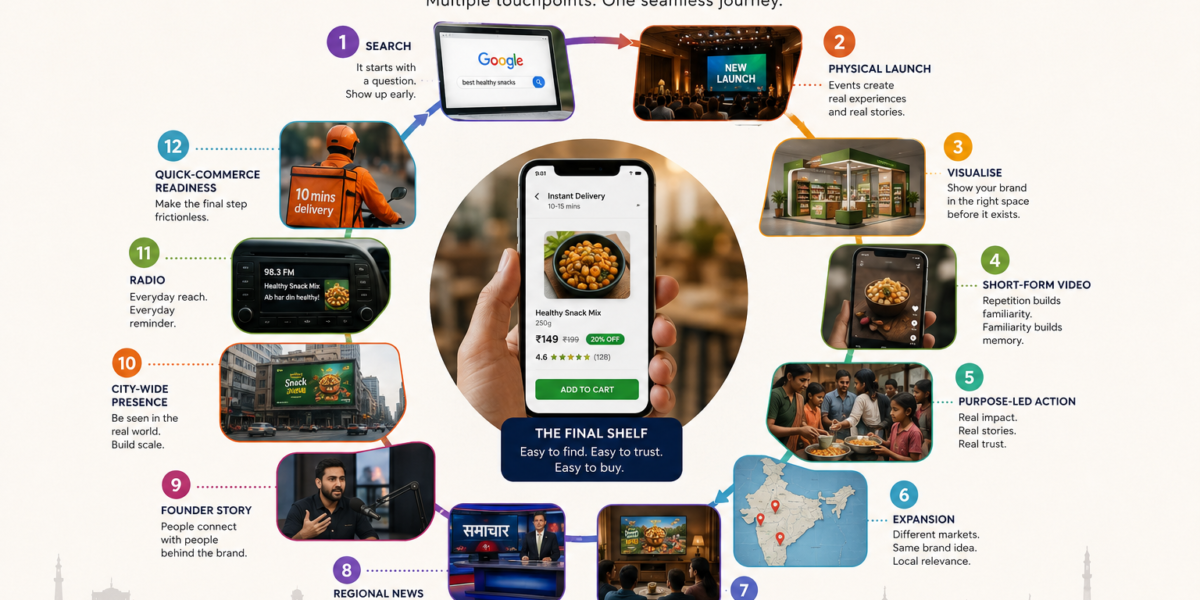
Consumer brands do not grow only because they have a good product.
They grow because the right people notice them, understand them, remember them, trust them, find them easily, and finally decide to buy them.
That journey often begins much earlier than the first order.
A person may see a product on social media, hear about it from a friend, notice it in a retail display, watch an advertisement with family, come across a founder interview, read a story about the brand, or spot it while browsing a quick-commerce app. None of these moments may immediately create a purchase. But together, they shape familiarity.
This is what separates a product from a brand.
A product can be listed online and still remain invisible. A brand becomes part of the customer’s memory long before they are ready to buy. When the need eventually appears, the customer already knows the name, understands the category, and feels more confident choosing it.
For Indian consumer brands, especially in food, personal care, wellness, household products, beauty, beverages, lifestyle, D2C, health products, and FMCG categories, the real challenge is not only getting discovered once.
The challenge is building repeated, meaningful discovery across many different environments.
Search Is the First Shelf
Before a customer walks into a store, opens a quick-commerce app, watches a campaign video, or speaks to a retailer, they often search.
They search for the category. They search for alternatives. They search for comparisons. They search for reviews, ingredients, benefits, prices, availability, and nearby options.
That means search visibility is no longer only a technical marketing activity. It has become part of product discovery.
A brand that does not appear when customers are researching the category is effectively leaving the first shelf empty for competitors. The customer may never know the product exists, even if it is better, more affordable, or more relevant than other options already visible in search results.
A strong search-first growth foundation helps a business think beyond ranking for its own brand name. The real opportunity is to become visible for the questions customers ask before they know the company exists.
For example, a wellness brand may need to appear when someone searches for healthier snack options. A skincare company may need visibility around a specific skin concern. A food brand may need to appear when people are looking for ingredients, recipes, alternatives, or new product categories. A home-care brand may need to be discoverable when customers compare different solutions to a daily problem.
Search does not create the whole brand story, but it often begins the relationship. It is the place where curiosity becomes consideration.
A Physical Launch Can Make a Brand Feel Real
Digital campaigns are essential, but there is still something powerful about a customer, distributor, retailer, creator, journalist, or business partner experiencing a brand in person.
Physical events create proof.
They give people a chance to see the packaging, understand the product, meet the team, ask questions, taste the product, compare variants, interact with the founder, and experience the brand environment directly.
For businesses planning large-scale launches, exhibitions, retail showcases, trade events, or corporate gatherings, a venue like Bharat Mandapam at Pragati Maidan can become more than a location. It can become a stage for credibility.
A product launch inside a well-planned exhibition or event environment gives the brand a stronger visual identity. It creates photographs, videos, media moments, customer interactions, retailer conversations, influencer content, and sales leads.
The brand should not treat the event as a one-day activity.
The event should become the start of a larger communication cycle.
The launch content can later be used in advertising, social media, product pages, distributor presentations, retail conversations, paid campaigns, and future announcements. A strong physical event creates material that continues working long after the lights are turned off.
Visualising the Brand Before It Reaches Every Shelf
For growing consumer businesses, one of the biggest challenges is making the product look consistent everywhere.
The packaging may look strong in person but weak on a small mobile screen. The product may look attractive in a studio shoot but not fit naturally inside a retail environment. The brand may need to show an upcoming kiosk, store, experience centre, exhibition stall, or retail setup before construction is complete.
This is where architectural visualisation for commercial spaces becomes useful.
A consumer brand can use 3D visualisation to show what a retail display, activation zone, flagship store, product kiosk, exhibition booth, restaurant counter, wellness centre, or future retail environment could look like before it physically exists.
This is particularly valuable when the business is speaking to investors, retail partners, mall operators, distributors, event planners, or franchise prospects.
The audience does not always need another presentation full of text. Often, they need to see the idea clearly.
When a retail concept looks real, the business feels more prepared. When a future space is visible, the expansion plan feels more credible. When a product is shown within the right environment, the customer can imagine how it belongs in their own life.
Short-Form Video Creates the Repetition That Brands Need
Most customers do not remember a brand after seeing it once.
They remember it after seeing it several times in different contexts.
A short video may introduce the product. Another may show how it is used. Another may explain a benefit. Another may feature a customer. Another may show a founder. Another may highlight packaging, ingredients, everyday use, or availability.
These small moments create familiarity.
That is why short-form content is not only for entertainment. It is one of the most useful tools for repeated brand exposure.
Professional Instagram Reels editing can help a consumer business turn raw footage, product shoots, customer clips, founder conversations, retail videos, event footage, and behind-the-scenes moments into content that works naturally on mobile screens.
The strongest Reels do not try to explain everything at once.
They focus on one simple thought.
A product benefit. A customer problem. A daily routine. A new flavour. A quick demonstration. A before-and-after moment. A founder observation. A useful tip. A retail launch. A limited edition. A reason to try the product.
When a brand keeps showing up with useful, visually clear, and recognisable content, it starts building memory. The customer may not buy immediately, but they begin to recognise the product when they see it again.
That recognition makes the eventual purchase easier.
Purpose Should Feel Real, Not Borrowed
Modern customers notice when brands try to attach themselves to social causes only for publicity.
A message about sustainability, nutrition, education, health, women empowerment, local employment, or community support means very little if it is disconnected from the way the company actually operates.
Purpose has to be built through action.
A food brand, for example, may genuinely care about nutrition, food access, waste reduction, responsible sourcing, farmer support, or community meals. But the communication should never make social impact feel like an advertisement.
It should show real work, real outcomes, and real people with dignity.
The storytelling principles seen in food-security NGO marketing are relevant here. Strong impact communication focuses on the issue, the people affected, the solution being created, and the long-term value of support.
Commercial brands can learn from this approach.
A business should not ask, “Which cause will make us look good?”
It should ask, “Where can we contribute in a way that is connected to what we genuinely do?”
When purpose is aligned with the business, customers can feel the difference. The brand becomes more believable because its actions support its message.
Expansion Needs More Than One National Campaign
India is not one consumer market.
A brand that performs well in Mumbai may need a different approach in Hyderabad. A product that works in Pune may need different messaging in Delhi. A campaign that creates awareness in one state may need a different creative, language, media plan, offer, and distribution strategy in another.
This is why businesses need to think in terms of market clusters rather than simply national reach.
A structured multi-state campaign approach can help brands coordinate communication across different regional markets without losing the consistency of the larger brand story.
The central promise can remain the same, but the way it is expressed should adapt.
A family-oriented product may need a different tone in one state than another. A value-driven product may need stronger retail messaging in a price-sensitive market. A premium brand may need more education before trial. A health-focused product may need expert explanation. A local-language campaign may need cultural references that do not appear in the national creative.
The strongest expansion strategy does not force one advertisement everywhere.
It builds one brand idea and lets each market experience that idea in a relevant way.
Entertainment Builds Emotional Recall
Consumers do not only make decisions through logic.
They also make decisions through familiarity, emotion, routine, and shared household experience.
A product that appears during entertainment content can become part of a family’s everyday media environment. It may not create an immediate purchase, but it can create a deeper kind of recall.
For brands targeting broad household audiences, a Zee Cinema advertising campaign can help create visibility in an environment where viewers are relaxed, emotionally engaged, and often watching together.
This can be useful for food products, personal care, home products, wellness brands, family services, retail offers, appliances, insurance, education, local services, and consumer technology.
The creative should match the context.
A family audience may respond better to warmth, humour, aspiration, everyday usefulness, shared moments, and simple product benefits than to technical advertising language.
The strongest entertainment-led campaigns make the brand feel familiar before it becomes necessary.
When the customer later sees the product at a store, in an app, or on a marketplace, the brand already feels known.
Regional News Can Make a Brand Feel More Credible
There is a difference between being visible and being credible.
A brand may receive thousands of views on social media, but customers may still hesitate if they do not understand the company, trust the promise, or feel confident about the quality.
Regional news environments can help businesses create a different kind of visibility.
For brands looking to build stronger relevance in Maharashtra, ABP Majha advertising can support communication in a Marathi news context where audiences are already engaged with regional developments, business stories, public issues, and everyday information.
This can be useful for consumer launches, healthcare awareness, education campaigns, financial services, real-estate communication, retail expansion, regional product availability, local entrepreneurship, and public-interest campaigns.
The important thing is that the brand message should respect the environment.
It should be useful, relevant, and clear. It should not feel like noise.
When a business appears in a trusted local context, it can become easier for the audience to take the brand seriously.
Founder Stories Give Brands a Human Voice
Customers increasingly want to know who is behind the product.
They want to understand why the business was started, what problem it is trying to solve, how the founders think, what quality standards matter to them, and what makes the product different from another option on the shelf.
A founder story can make a brand feel more human.
It can also make a business feel more accountable.
Instead of relying only on packaging, slogans, and product shots, a company can create a conversation where the founder explains the journey, the category, the customer insight, and the long-term ambition.
A well-planned founder interview format can help a business create authority-led communication without making it feel like a conventional advertisement.
The strongest founder interviews are not self-congratulatory.
They are useful.
They explain a problem. They discuss a customer need. They offer a perspective on the industry. They show why the business exists. They help the audience understand the values behind the product.
For younger brands, this can be one of the fastest ways to create trust. The founder becomes part of the proof.
Cities Need More Than Digital Attention
Digital campaigns are powerful, but there are moments when physical visibility matters just as much.
A customer walking into a cinema, travelling through a city, passing through a busy road, visiting a mall, commuting to work, or moving through a high-footfall area is still exposed to brand messages in the real world.
For campaigns targeting the Hindi-speaking market, a cinema and out-of-home advertising strategy can help brands think beyond the screen in a person’s hand.
Cinema and outdoor advertising can create a strong sense of scale.
A brand on a large screen feels more established. A campaign repeated across prominent locations creates visual memory. A product that appears in the customer’s everyday environment can feel more present and more real.
This is especially useful for launches, retail expansion, festival campaigns, new product categories, real-estate projects, consumer technology, auto products, healthcare services, education campaigns, and regional growth plans.
Physical media should not replace digital campaigns. It should strengthen them.
When a customer sees the same brand on the road, online, in a cinema, on social media, and inside a marketplace app, the brand begins to feel larger than a single advertisement.
Radio Can Build Everyday Familiarity
Not every brand message needs a large television campaign or a high-budget launch film.
Sometimes, frequency matters more than spectacle.
Radio remains useful because it appears in daily routines. It reaches people during commutes, store visits, work hours, travel, local business activity, and community life.
For businesses targeting Maharashtra, a Marathi radio advertising approach can help create regular local visibility without depending entirely on one large campaign.
Radio works especially well when the message is simple.
A new product is available. A store has opened nearby. A seasonal offer has started. A service is now available in the city. A local event is happening. A new location has launched. A trusted brand has entered the market.
The advantage of radio is that it can make a brand feel present in everyday life.
A listener may hear the name while travelling in the morning, hear it again while shopping in the evening, and later recognise the same product on a quick-commerce app.
That repetition creates familiarity.
The First Order Happens at the Final Shelf
Every marketing activity eventually has to lead somewhere.
A brand may create strong videos, run local campaigns, appear in media, host events, build search visibility, and create customer interest. But the effort can still be wasted if the product is difficult to find, unclear on the app, poorly presented, or unavailable when the customer is ready to buy.
For food, beverage, personal care, household, wellness, and FMCG brands, quick-commerce platforms have become one of the most important final shelves.
The customer is not standing in a store aisle. They are looking at a small screen. They are comparing thumbnails, prices, pack sizes, offers, product names, ratings, categories, and delivery speed.
A useful Swiggy Instamart selling guide can help a growing consumer brand think through the practical details that affect conversion once demand has already been created.
The product image needs to be clear.
The title needs to make sense quickly.
The packaging must work at a small size.
The offer should be easy to understand.
The product should be available when the customer wants it.
The customer journey should not create doubt at the final moment.
Marketing creates desire. Availability turns desire into revenue.
Final Thoughts
The strongest consumer brands do not rely on one platform, one campaign, or one type of content.
They build a discovery loop.
A customer may first find the brand through search. Then see it in a Reel. Then notice it at an event. Then hear about it through local media. Then watch a founder interview. Then recognise it in a cinema campaign. Then see it again during a commute. Then finally add it to a quick-commerce cart.
Each moment may seem small on its own.
But together, they create familiarity, confidence, and demand.
That is how a product begins to feel like a brand.
And that is how a growing Indian business moves from being discovered once to being remembered when it matters most.